
How We Got Here - The Middle East Crisis Explained
You may have heard your parents complain about gas prices or seen President Trump complain about Iran on the news. It seems that all eyes are on the Middle East. Yet, how did we get here? Why is there war, and why are we involved? It may seem very confusing, so here is a simplified breakdown of why all this fighting is happening.
To give some context: in the late 1800s, a movement called zionism started. Zionism is a nationalist belief that the Jewish people (who had been oppressed for centuries) should have a nation in the holy land. At that point, the region of the holy land was known as Palestine, and had a massive Arab population as part of the Ottoman Empire. Nevertheless, several thousand Jews immigrated to Palestine which they viewed as their historic homeland. Following World War One, the United Kingdom gained control of Palestine. Tensions and violence grew between the local Palestinian Arabs and the Jewish settlers. After the end of World War Two in 1945 and the Holocaust, Jewish immigration spiked and atrocities were committed by both sides. The British were left very weak after the war, and so the newly formed United Nations stepped in. The U.N. opted to partition Palestine, with the Jews getting around 55% of the land (although they had 33% of the population at the time) and the Palestinians receiving around 45% of the land (while they were 67% of the population). This plan was rejected by many Arab countries, yet it received support from most Allied and Western nations and was passed. Palestine would be made up of two states: the Gaza Strip and the West Bank. In 1948, Israel was officially founded. This declaration was immediately met with hostility as Israel’s Arab neighbors declared war, which they lost. This is seen by many as the start of what would be known as the Arab-Israeli conflict. Over the decades since, several more incidents would occur; the Arab nations continued to try and defeat Israel as Israel displaced millions of Palestinians.
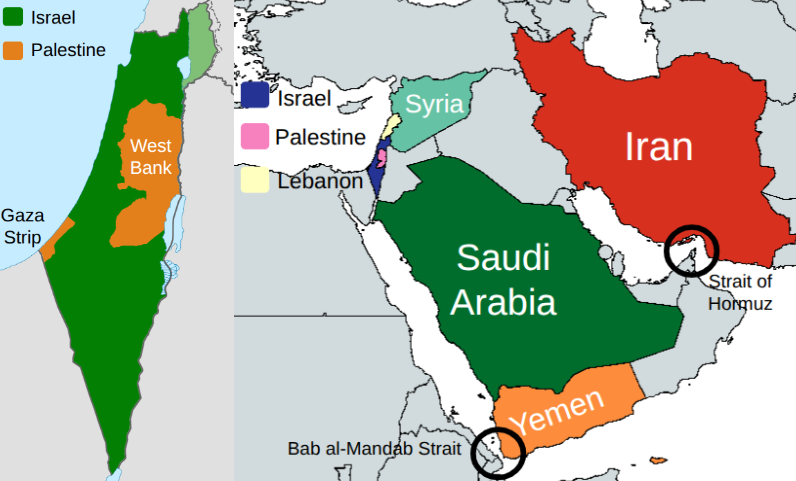
A map of Israel (L) and the Middle East (R).
By the 2020s, the Arab-Israeli conflict had taken a different shape. Palestine had obtained a governing body in the 1990s, yet it is very weak, only operating in the West Bank, which has been under Israeli occupation for nearly 60 years. Today, the biggest foe against Israel is none other than Iran. In 1979, Iran experienced a violent revolution and was turned into an authoritarian theocracy determined on destroying Israel and their biggest ally, the United States, under the leadership of the Supreme Leader, who serves a life tenure (and is commonly referred to as “the Ayatollah”). Iran is weaker than Israel militarily, geopolitically, and economically. This has prompted Iran to supply and support a network of proxies to counter Israel and the U.S.. This coalition is referred to as the Axis of Resistance. The major proxies of this group are Syria and the terrorist groups Hamas, the Houthis, and Hezbollah. Hamas gained control of the Gaza Strip in 2007, and has been a major threat to Israel, with the two engaging in many deadly skirmishes.
On October 7th, 2023, Hamas executed a massive attack which they claimed was in defense of Palestine. Thousands of rockets were fired and an incursion from Gaza into Israel was launched. In what would become Israel’s single deadliest day and one of the largest terrorist attacks ever, 1,195 civilians were killed. A total of 251 people were taken hostage by Hamas. On top of that, the United Nations later reported that torture, rape, and mass killings were committed. In response, Israeli Prime Minister Benjamin Netanyahu declared a state of war and Israeli forces mobilized thousands of troops. Israel’s objectives were to recover the hostages and to annihilate Hamas. This would be the start of the Gaza War. By the end of October, Israel started an intense bombing campaign and launched an invasion of Gaza, repelling Hamas’s incursion. A brief ceasefire was reached in November where some hostages were exchanged for Palestinian prisoners, but it soon fell apart and hostilities continued. Israel pushed into northern Gaza, ordering civilians to flee their homes although these evacuation orders were criticized for their ambiguity and inaccessibility. Hamas turned to guerilla tactics to combat the invading force. By 2024, Israel had turned its attention to southern Gaza and more offensives occurred. Several sieges would be ordered and air strikes intensified.
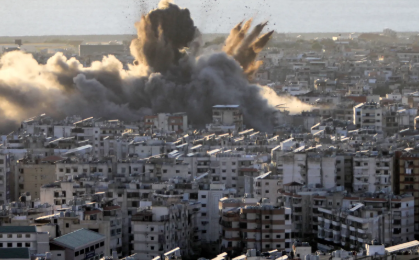
An Israeli strike on Lebanon in 2024.
However, the fighting was escalating beyond just Gaza. Immediately after the October 7th attacks, Hezbollah (which is based in Lebanon) fired rockets at Israel in solidarity with Hamas. Border clashes started, eventually culminating in a ground invasion against southern Lebanon in October 2024. The assault severely crippled Hezbollah and several top leaders were assassinated. Israel withdrew after a ceasefire was reached in November. Following October 7th, the Houthis, based in Yemen, fired missiles as well. They turned to attack or seize vessels they deemed linked to Israel or the U.S. in the Red Sea. This has led to a disruption of global maritime trade. Also in response to the war, settler violence in the West Bank surged. Clashes broke out between the Israeli Defense Forces and Israeli settlers with Palestinians causing mass displacement and violence as Israel aims to further advance its control of the territory. The situation in the West Bank has only escalated in the years since. Iran even got involved and exchanged air strikes with Israel on a few instances, marking the first time the two directly attacked each other. Syria also was affected as their government collapsed in December 2024 after a very swift and successful campaign by opposition forces. A transitional government was set up, and Syria unofficially left the Axis of Resistance. Meanwhile the United States was getting roped into the conflict. Under the then-President Joe Biden, the U.S. maintained its support for Israel and billions of dollars worth of aid and weapons would be given. However, a rift would form between him and Netanyahu as it became clear that Israel was deliberately targeting civilians in Gaza. The U.S. started providing humanitarian aid to those in Gaza, but nevertheless continued to back Israel. They helped intercept missiles directed at Israel, launched air strikes against the Houthis, and also mediated peace talks alongside Qatar and Egypt. One of the last things Biden did as president was achieve a ceasefire in January 2025 between Hamas and Israel.
By 2025, the crisis in the Middle East was taking a new shape. In January, Donald Trump was re-elected for a second nonconsecutive term. At that point, the aforementioned ceasefire was in effect. Hostages taken by Hamas during October 7th were exchanged for thousands of Palestinian prisoners held by Israel. However in March, the truce ended after both sides stalled negotiations on moving through with the next stage of the ceasefire which culminated in Israel launching strikes on Gaza, officially resuming the conflict.
Then on June 13th, Israel attacked Iran, aiming to harm Iran’s nuclear capabilities and leadership. Several Iranian military commanders, long-range missile targets, and nuclear scientists were taken out. This would be known as the Twelve-Day War. Iran retaliated and strikes between the two continued. Later in the war, the United States joined the war yet a ceasefire went into effect just a few days later on the 24th. The war weakened Iran, and marked a turning point since now a direct war with Iran wasn’t a hypothetical anymore.
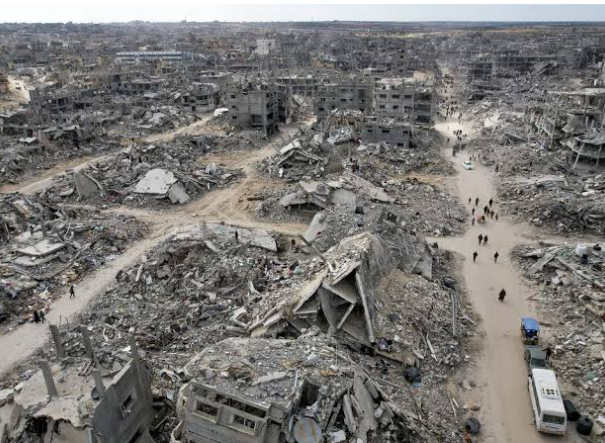
An image of Gaza from late 2025.
In October 2025, a third ceasefire brokered by President Trump was announced in Gaza, which is still implemented as of this article’s publication. Under pressure, Hamas gave up all remaining hostages and agreed to disarm. It later announced the dissolution of its governing body over Gaza. Although war has stopped, Israel still controls 70% of Gaza In fact, Israel committed several atrocities since the start of the war. Even prior to the war, Israel had massive control over Gaza, since it controlled its borders, shipments, airspace, and coastlines. During the Gaza War, Israel cut off the Strip’s electricity and heavily limited its access to clean water. As the war continued, it was very clear Israel was actively targeting civilians and civilian architecture. The United Nations estimates that at least 80% of buildings in Gaza have been damaged or completely destroyed. Gaza is reported to have the highest number of child amputees per capita and contains around 60 million tons of rubble. Through the use of blockades and bombardments by Israel, a food, humanitarian, and healthcare crisis was triggered. The U.N. declared that a famine had occurred in August 2025. Israel and Benjamin Netanyahu have received international condemnation. At the very least, 70,000 Gazans have been directly killed with a minimum of 170,000 reported injured. Nearly 2 million are displaced from their homes. Now, a year later after the ceasefire’s announcement, peace negotiations have stalled. Israel is yet to withdraw from Gaza and fully end strikes while Hamas hasn’t disarmed.
Meanwhile, it became clear that under President Trump the United States wasn’t done with the Middle East. This was evident when he ordered strikes on the Houthis in March (which led to a ceasefire in May 2025) and when the U.S. joined Israel in the Twelve-Day War. Even during his first term, Trump took an aggressive stance against Iran. He controversially withdrew the U.S. from the JCPOA, a deal that restricted Iran’s nuclear program, and also assassinated a top Iranian general in 2020. By 2026, relations with Iran were at an all-time low. Nuclear negotiations were falling through, and Iran’s violent response to protests at the time only worsened ties. That, compared with Netanyahu’s private persistence to urge Trump to conduct joint-military operations on Iran, resulted in a massive American military buildup in the Middle East.
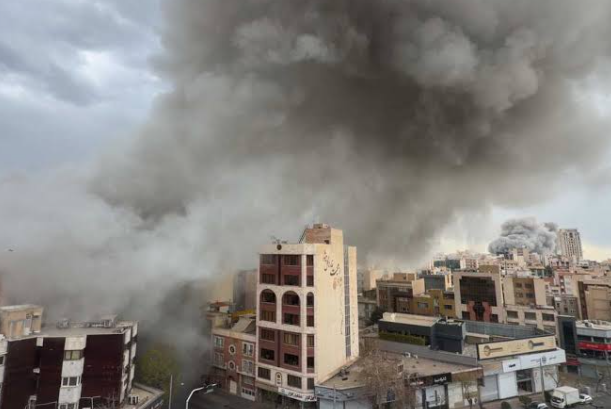
A strike on Iran from 2026.
On February 28th, 2026, Israel and the United States launched hundreds of strikes with the reported goals of regime change and preventing Iran from developing nuclear weapons. Several more top leaders were killed, including the Ayatollah Ali Khamenei. Iran retaliated, and the Iran War had begun. Days later Israel again invaded southern Lebanon to target Hezbollah after they exchanged strikes. Iran has taken a defensive approach to the war and extensively targets the Strait of Hormuz, a vital trade waterway in which a fifth of the world’s oil supply travels through. It also exports massive amounts of natural gas. Iran has laid mines in the Strait and attacked commercial vessels in order to jeopardize global trade and put immense pressure on the U.S.. Iran repeatedly has used its control of the Strait to gain leverage. As travel through the Strait declined to an abysmal level since February, international oil and gas prices have skyrocketed, impacting millions on a global scale. Prior to the war in the U.S., gas prices jumped from $2.98 per gallon to a current national average of $4.36. Hostilities continued until April when a ceasefire was reached between Israel and the U.S. with Iran. Eventually a truce with Hezbollah was also achieved, although to this day Israel occasionally strikes Lebanon. The U.S.-Iran ceasefire was incredibly fragile. Threats (especially from Trump) and accusations were rampant, and the crisis with the Strait of Hormuz had not been solved. Negotiations weren’t accomplishing much, with Trump and his administration facing an extreme amount of backlash mainly due to rising gas prices, failing to accomplish the war’s objectives, contradictory claims, and starting the war without congressional approval. In July, the ceasefire officially collapsed. Off-and-on again strikes resumed between Iran and the U.S.. This post-ceasefire phase of the Iran War was made worse due to the fact that the Houthis launched an offensive and seized Yemen’s entire coastline with Red Sea and Bab al-Mandab Strait, another vital waterway that provides a shortcut for cargo ships. This prompted Saudi Arabia to renew offensives against the Houthis, its longtime enemy, which has only escalated things. The U.S. is reportedly weighing options on how to deal with the new Houthi threat.
Now in October 2026, it is clear the Middle Eastern Crisis nowhere near ending. This spiral of events dating back to the October 7th attacks has snowballed into a regional war which has changed the lives of millions and killed hundreds of thousands. In a few weeks, both Trump and Netanyahu face elections which could both lead to a shift in the conflict, but it still won’t fix things; at least not soon. Regardless, it is important to stay informed, look back at the Arab-Israeli conflict, and keep an eye on headlines in order to truly understand what is happening and to form your own opinions of what is ongoing in the Middle East.
Image 1: https://commons.wikimedia.org/wiki/File:Israel-Palestine_Locator.png
Image 2: Paul Donovan, made with https://www.mapchart.net/
Image 3: https://www.axios.com/2024/10/21/israel-us-lebanon-end-war-conditions
Image 5: https://www.npr.org/2026/03/02/g-s1-112151/iran-war-widens-threatens-to-engulf-lebanon
Thumbnail: https://news.un.org/en/story/2024/01/1145742

