
Every two years, all 435 seats in the House of Representatives and a third of the 100 seats in the Senate are up for election. A party must win 218 seats in the House and 51 in the Senate to win it over. In 2024, Republicans won control of the House, Senate, and also the White House. Congressional elections between presidential elections are referred to as midterm elections since they are in the middle of the president’s term. The party that wins the midterms shapes a president’s time in office as they could either block or pass their policies in Congress. Statistically, the president’s opposition party wins the midterms, and 2026 is no different. Since Donald Trump’s return to the Oval Office in January of 2025, Americans have not been satisfied with his tenure as the 47th president. Whichever party wins Congress will define his final two years in office. Many news outlets predicted a “blue wave” for Democrats, so how did things play out?
Last summer, in order to preserve their narrow majorities in both the House and Senate, President Trump pushed Texas Republicans to pass a new congressional map that gave the Republicans an upper hand in five districts. This practice is referred to as gerrymandering; this is when a party manipulates electoral district boundaries to gain an advantage. The Democrats responded to Texas’s redistricting by approving a new map for California and later Utah. However, the Republicans succeeded in making new congressional maps for Ohio, Alabama, Florida, Louisiana, Tennessee, and North Carolina. Yet, when the 2025 elections came around, the Democrats swept the gubernatorial elections in Virginia and New Jersey as well as the New York City mayoral election. Clearly, not everyone was happy.

Michigan Senate candidates Mike Rogers (R) and Abdul El-Sayed (L) during a televised debate on October 8th.
By the following year in 2026, things were not looking good for Republicans. Trump’s controversies involving ICE, Jeffrey Epstein, tariffs, Iran, and rising cost-of-living prices left millions with a bad taste, which became a liability for the party. In particular, the President’s immigration and economic policies alienated plenty, especially Hispanics and farmers, many of which voted for him in 2024. For the midterms, not only could Democrats (who already have the historical advantage) win, but they could potentially sweep. After all, they only needed at least four seats in both the House and Senate to achieve the majority needed. They advocated for affordability, better access to healthcare, stopping corruption in the Trump Administration, and a close to the Iran War. These policies resonated with millions of Americans especially since many already had a general anti-Trump sentiment, more specifically young voters and independents. Red leaning states began shifting more blue, leading to much closer races and toss-ups. Kansas, Maine, South Carolina, Iowa, and more became battleground states. The most famous of these battleground races were for the Senate seats in Texas and Michigan. In Michigan, Dr. Abdul El-Sayed faced off against the Trump-endorsed Representative Mike Rogers for a chance to become the Senate’s first Muslim member. As for Texas, Representative James Talarico looked to achieve an upset win against state Attorney General Ken Paxton who is also backed by Trump. Both Talarico and El-Sayed have reached national fame during this election cycle. Politicians like former President Barack Obama and former Vice President Kamala Harris campaigned at rallies while celebrities such as Bruce Springsteen endorsed Democratic candidates.
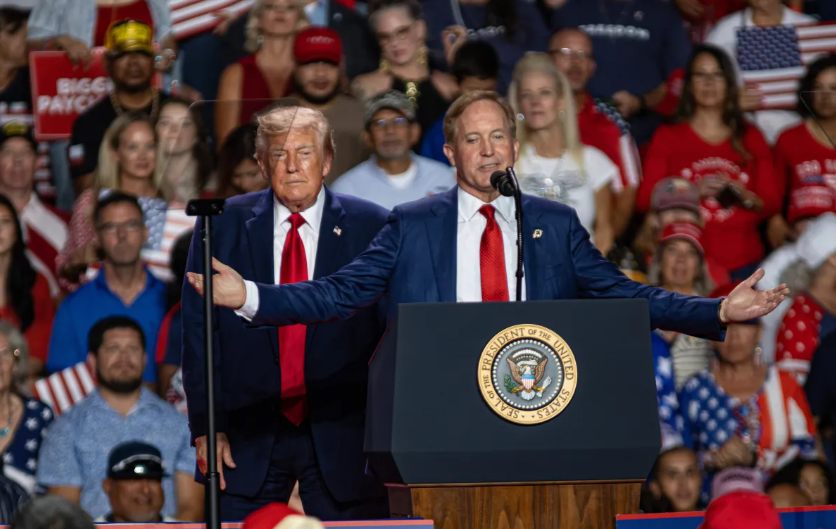
President Trump alongside Republican Senate nominee Ken Paxton at a San Antonio rally, October 7th.
Republicans meanwhile campaigned to expand Trump’s agenda, tackle immigration, cut taxes, and promote domestic manufacturing. Although billions of dollars went to backing both parties, Republicans had the financial advantage. Elon Musk was the midterms’ biggest contributor who donated nearly half a billion dollars towards Republican candidates. Regardless, ads and money were utilized defensively. Funding was devoted more to states that are safely red, meaning toss-up races could be conceded to Democrats. On top of that, a lot of Republicans were struggling in their new gerrymandered districts. President Trump’s unpopular policies were harming Republicans. Speaking of the president, Trump made sure he took the forefront of the Republicans’ midterm campaign. Early on in the race, he got involved in the party’s primaries and endorsed candidates more aligned with him. Furthermore, he excessively appeared at rallies and campaigned across the country. Regardless, his approval rating was hovering around 31%, a record low across both his presidencies. The President also made several weird remarks while on the campaign trail, like urging voters to “Pretend I’m on the ballot”. As early voting hit a high turnout of over 50 million, Trump took more forceful measures. On October 23rd, he had the Department of Justice file a lawsuit involving the Alaska Senate race saying the state did not have to certify the votes if the Democratic candidate won. This was justified due to the Republican candidate having a name too similar to an independent also on the ballot which he stated would cause confusion for voters. The lawsuit was eventually dismissed by a judge on November 1st. On October 26th, Trump took to Truth Social to offer a $1 million bounty for those who report voter fraud, and his administration also allocated 20 million in taxpayer dollars to air pro-Trump ads (which were later struck down by another judge). Nevertheless, Republicans dwindled and were struggling to preserve their seats.
On November 3rd, Election Day came, where over 120 million cast their ballots. When the results started coming in, it was clear: the Democrats had won in a blue tsunami. Of the 35 seats up for election in the Senate, the Democrats flipped seven held by Republicans to secure 54 seats. For the House, Democrats flipped an astounding 42 seats to gain a total 254 so far. The Republicans meanwhile currently have 44 seats in the Senate and 162 in the House. In the 36 states that had gubernatorial elections, five flipped in favor of the Democrats. By the time of this article’s publication, 23 races still haven’t been called yet. The Democrats’ win brought a lot of firsts for the nation. Texas elected its first Latina governor in Gina Hinojosa and New Hampshire Senator-elect Chris Pappas is the first openly gay man elected to the chamber, just to name a few. The new Congress will be sworn in on January 3rd, 2027.
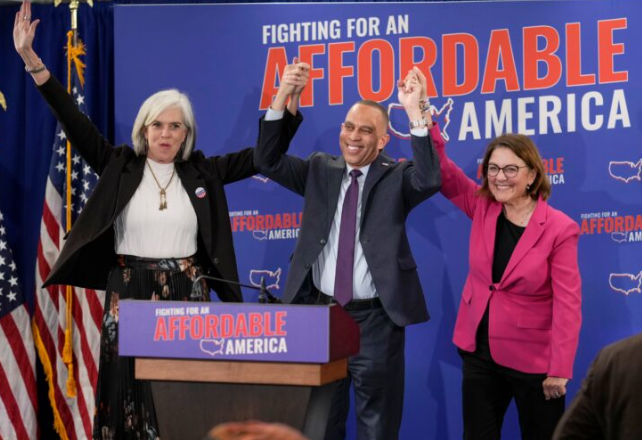
House Minority Leader Hakeem Jeffries (middle) during his victory speech.
Although losses were anticipated, the Republicans’ defeat was overwhelming. Florida Governor Ron DeSantis dubbed the loss “close to an extinction-level event for Republicans.” They underperformed in parts of the country, and most races in red states were much closer than expected. A lot of the new gerrymandered maps did not pay off and numerous Republicans lost in these redrawn districts. President Trump’s involvement in the election also backfired. Many of his handpicked candidates lost which gave the Democrats a lot of upset victories. Americans nationwide clearly were sick of the extremely unpopular Trump Administration and opted to vote blue to try and put an end to their policies. Pretty soon after the results came out, Republicans started playing the blame game. Vice President JD Vance directly cited the Iran War as the reason for the party’s loss. Trump himself reiterated several times in interviews that he has the power to veto bills passed by Congress. A large number of Republicans in Congress meanwhile turned on Defense Secretary Pete Hegseth who could now potentially face impeachment. Although there is still a good two years until the 2028 presidential election, these midterms have shaken things up for the Republicans. This cycle has shown that Trump’s endorsements do not have as much significance anymore, and evidently do more harm than good. In fact, many possible candidates may have to stray away from any ties to Trump in order to have a fair chance of succeeding.
In the meantime, the country is patiently waiting to see what the Democrats will do given their tremendous majority. Will AI be regulated? Could President Trump face a third impeachment? Will prices be lowered? Could the Iran War be brought to an end? 2027 has a lot in store for the trajectory of the country, and only time will tell which direction the Democrats will steer towards.
Image 1: https://bridgemi.com/michigan-politics/fact-check-abdul-el-sayed-and-mike-rogers-debate-trump-tariffs-war-more/ Image 2: https://www.texastribune.org/2026/10/08/texas-senate-james-talarico-flu-ken-paxton-debate-trump/ Image 3: https://whyy.org/articles/election-2026-democrats-win-us-house-senate-trump/ Thumbnail: https://www.opb.org/article/2026/11/04/2026-midterms-democrats-win-the-senate/